
Over three days at Arizona State University last week, the National Journalism + AI Accelerator brought together journalists, technologists, researchers and funders to grapple with a central question: How do we adopt AI in ways that strengthen local journalism, not weaken it?
Hosted by NEWSWELL and the Knight Center for the Future of News, the convening focused less on chasing tools and more on leadership, culture and intention.
From opening keynotes to hands-on breakout sessions and fast-paced idea sharing, participants pushed past hype to focus on what is already working — and what still needs to change. One of the strongest throughlines was a willingness to engage AI critically and constructively. As one participant observed: “I saw a lot of people taking a really healthily critical stance to some of this stuff in a way that builds but also does so in a safe way. That makes me very optimistic.”
That balance showed up again and again. Conversations emphasized that responsible AI adoption requires more than efficiency gains. It requires trust, governance and newsroom cultures that support experimentation without fear.
Just as important, participants spent significant time working through what they could take home and apply immediately.
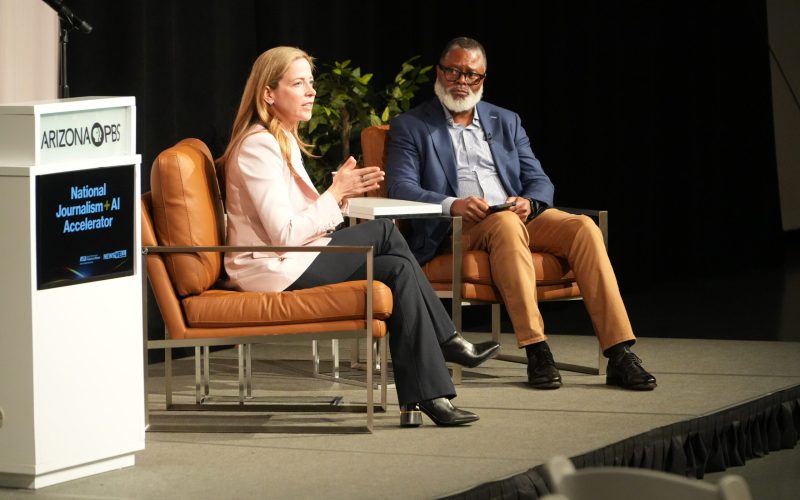
5 takeaways from the accelerator
1. Start with the problem, not the tool. Across sessions, participants repeatedly emphasized reframing the AI conversation. Instead of asking, “How can we use AI?” newsrooms are encouraged to ask, “What problem are we trying to solve?” Pain points around workflow bottlenecks, audience understanding and data overload came up far more often than specific tools — with AI positioned as one possible solution, not the starting point.
2. Treat AI adoption as a culture challenge, not a technical one. Several discussions reinforced that the biggest barriers to AI usage are rarely engineering-related. As one participant put it, “It is not about technology, but it’s still about newsroom culture.” Suggestions included creating low-stakes spaces to experiment, such as internal “code clubs,” short sprints to test ideas and shared language that helps staff understand what AI is — and isn’t — being used for.
3. Build trust through governance and communication. Participants stressed the need for clear AI usage policies, steering committees and shared norms around data access and ethical use. These conversations should include skeptics, not just champions, so that experimentation can move faster once guardrails are in place.
4. Use AI to listen better to audiences, not just to publish faster.
Multiple sessions reframed journalism’s role as civic infrastructure. Participants explored how AI can help teams “pulse check” what communities care about, especially people who are not current subscribers or donors. Ideas included using AI to synthesize feedback at scale, test engagement prompts and design pathways that move audiences from casual interaction toward deeper participation.
5. Be bolder than efficiency gains. While AI has often been framed as a way to do the same work faster, speakers and participants challenged the field to think bigger. The conversation is shifting beyond efficiency toward reimagining what journalism can be and how it serves communities in an AI-driven world, observed Amalie Nash, vice president of journalism at the Knight Foundation, as she closed out the convening.
That push toward practical experimentation was evident throughout the accelerator — from immersive field trips showing AI in action at ASU, to breakout sessions on policy, revenue and audience engagement, to “Steal This Idea,” a rapid-fire showcase of tools and experiments already underway in newsrooms.
The takeaway was clear: AI is not a distant future for journalism. It is already here. The opportunity now is to lead with purpose, curiosity and care — and to build cultures that allow teams to experiment responsibly and learn together.
Thank you to our speakers, partners and participants for bringing the honesty, rigor and imagination that made this convening possible. We’re excited to carry this work forward.
This update originally appeared in our Jan. 12, 2026, newsletter. This version has been lightly edited for clarity.